September 27, 2026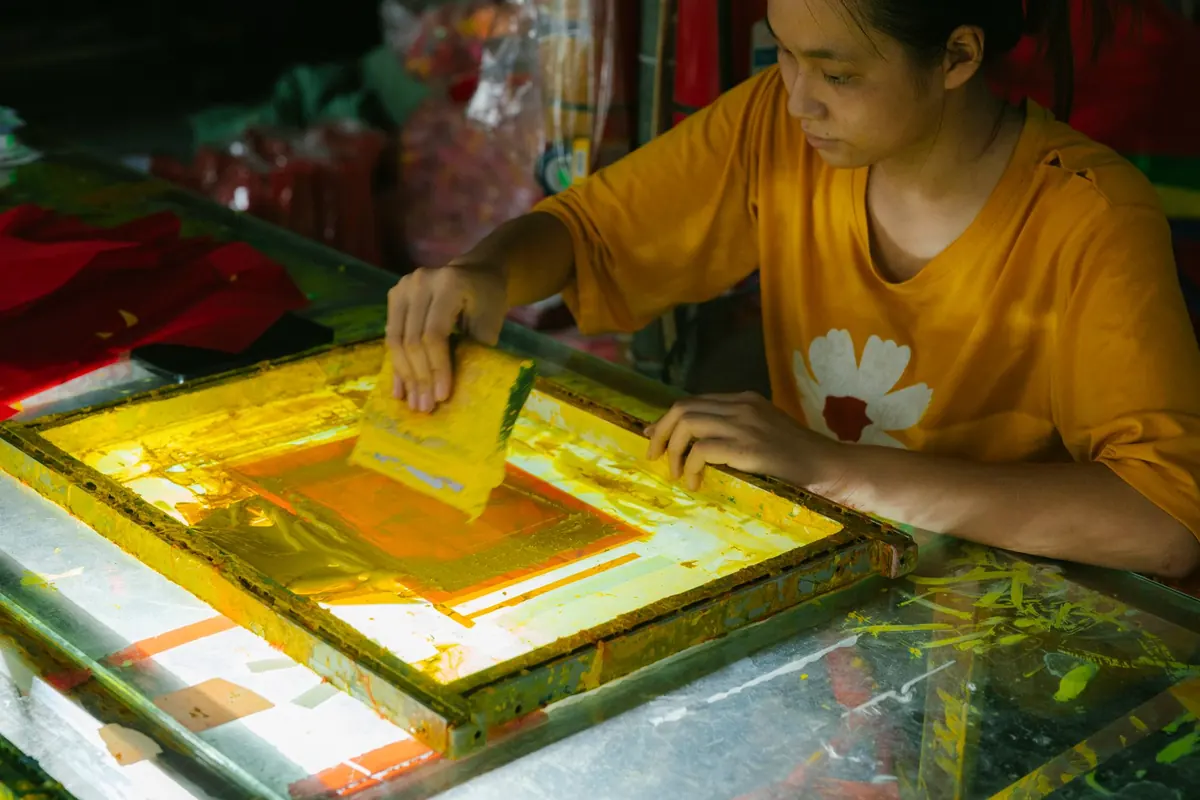
A giclée print and a screen print of the same size can hang on the same wall and feel like entirely different objects. One is smooth, with soft transitions and photographic detail. The other has a physical bite: flat, saturated colour and ink you can catch under a fingertip. Neither is better than the other, but they do different jobs — and knowing which one you are looking at will save you money and disappointment.
Two methods, two very different objects
Both start with an artist's image and finish with a print on paper. Everything in between is different.
Giclée: fine art inkjet
A high-resolution file — usually a scan or photograph of an original painting, sometimes a digital artwork — is printed on a professional inkjet printer using pigment inks and fine art paper. Prints are made one at a time. There are no screens, no setup costs and no minimum order. Colour is laid down in microscopic dots, so a watercolour wash or a soft pencil gradient comes through with all its nuance intact. The word is borrowed from the French for "sprayed" and was adopted in the 1990s to separate fine art inkjet work from the desktop sort. What matters is the ink and the paper, not the label.
Screen printing: one screen per colour
A mesh screen is stretched over a frame and the negative areas are blocked out with a stencil. Ink is pulled across the mesh with a squeegee and passes through the open areas onto the paper below. That is one colour. A four-colour screen print means four screens, four passes, four drying times and four chances to misregister. Which is exactly why screen prints look the way they do: bold, deliberate, graphic. The ink sits on top of the paper rather than soaking into it, giving that slight relief you can feel with a fingernail.
Colour depth: gradients versus flat punch
Giclée wins on range. Pigment inkjet printers blend many ink colours to produce an enormous number of tones, so skin, skies, fog and fine brushwork all read naturally. It is the obvious choice for reproducing a painting or a photograph faithfully.
Screen printing works in spot colours: a defined, mixed ink per screen. That gives flat areas of colour real punch — a red that stays the same red across the whole sheet. Gradients are possible, but they are built from halftone dots or blended pulls, and you will see the dots if you look closely. For a graphic poster or a bold illustration, that texture is part of the appeal. For a portrait with delicate shading, it is a compromise.
Texture and finish you can feel
With giclée, the paper does most of the talking. Smooth cotton rag gives a clean, modern look; textured etching papers add a soft tooth; canvas adds weave. The printed surface can be surprisingly delicate, so handle prints by the edges and avoid dragging anything across them.
With screen printing, the ink layer does the talking. Depending on the ink and paper, you might get a soft matte finish, a slight gloss that catches light at an angle, or visible dot structure in the mid-tones. Deckled edges and small registration variations are common — a sign of a hand-pulled print rather than a flaw.
Longevity: how long will it last?
Look after either type and it will outlast you. Pigment-based giclée prints on acid-free paper, framed behind UV-filtering glass and kept out of direct sun, can hold their colour for decades. Dye-based inks fade far faster, so it is worth asking which is used. Well-made screen prints are also lightfast, though cheaper inks can yellow or crack over time.
Rules that apply to both:
- Keep prints away from direct sunlight, radiators and damp rooms such as bathrooms and kitchens.
- Use acid-free mounts and backing boards, never masking tape or Blu Tack directly on the paper.
- Fit a spacer or mount so the print does not touch the glass, particularly with giclée, where the surface can stick or scuff.
- Store unframed prints flat, interleaved with acid-free tissue, not rolled in a warm cupboard.
Cost, editions and what you pay for in the UK
Giclée has a low barrier to entry. A single print can be produced economically, which is why you see editions of 25, 50 or 100 at accessible prices. Once the file is prepared, the cost per print is driven mainly by size and paper quality rather than quantity.
Screen printing is the reverse. Each colour needs a screen, and every print is pulled by hand, so setting up is the expensive part. Short runs in several colours cost a lot per print; long runs in one or two colours become very reasonable. That is why screen prints are often editions of 30 to 150, numbered and signed, and why a hand-pulled print frequently costs more than a giclée of the same size from the same artist. It is not automatically better — it is simply more labour.
Retail prices in the UK normally include VAT, so the figure on the label is what you pay. If you are buying unframed, budget for framing too: a decent frame with an acid-free mount can easily cost as much as a mid-priced print.
Which one suits you?
- Choose giclée if you want faithful detail, a specific size, or a one-off print, and you would rather spend on the paper than the process.
- Choose screen print if you love flat, saturated colour and graphic line, and you like the idea of a print that carries small variations from the hand that pulled it.
- Choose either if the image itself is what moves you — but check the ink, paper and edition details before you commit.
Buying well: questions to ask before you pay
Good sellers answer these happily, whether you are at a craft fair in Sheffield or buying from a small studio online.
Ask what inks are used and whether the paper is acid-free and of a stated weight — anything around 200gsm and up feels substantial in the hand. Ask about the edition size, whether the print is signed and numbered, and whether there are artist proofs in circulation. For giclée, ask how the colour was proofed: screens vary, so a print can differ slightly from the photograph on a website. For screen prints, ask which colourway you are buying, since the same design is often re-released in new palettes.
Finally, ask how it will be shipped. Tubes are cheap and safe for transit, but a print left rolled for weeks will curl; take it out promptly and press it flat under boards or books for a few days. Flat-packed is better if the seller offers it.
Buy the image you would still want on the wall in ten years, then let the method match the mood. Soft and atmospheric, go giclée. Loud, graphic and handmade in the most visible sense, go screen print. Both will serve you well if you frame them properly.
Photo: HONG SON / Pexels